
CASE STUDY
TEchSmith
Transforming content approaches across two products to a single unified strategy — and original data that gave them a conversation competitors couldn't copy.
Here's the trap every marketing team eventually falls into: Staying busy is easy to mistake for making progress. Blog posts ship, social goes out, the academy grows, and none of it is pulling in the same direction.
Your products solve a real problem, and your best customers know it. But the content tells a different story, or no clear story at all, while a competitor with a weaker product tells a sharper one. That gap is a window, and windows close.
That's where TechSmith was: two flagship products that could change how teams work, and a content operation that wasn't keeping pace with the opening in front of it.
TL;DR
CLIENT
TechSmith - B2B SaaS maker of screen capture and video tools for workplace communication (Snagit and Camtasia)
SITUATION
Two product lines, multiple teams, no shared content strategy, while competitors claimed the async-work conversation TechSmith was built to own
THE WORK
A unified content strategy with immediate friction fixes, plus an original research project built from the company's own async-first experiment
THE SHIFT
From scattered output to one narrative both products run on, anchored by data no competitor could copy
THE OUTCOME
A strategy teams could execute from, friction fixed for new users, and an eBook that put TechSmith in a conversation its rivals couldn't enter
The Challenge
TechSmith wasn't starting from zero. Snagit and Camtasia had real user bases, strong reputations, and genuine loyalty. The team was shipping — a blog, tutorials, social, email, an academy. Real assets, real audiences, real engagement. The problem was that everything pointed in slightly different directions.
Each product had its own audience, its own champions, its own idea of what the content should say. Marketing, customer success, and product each pulled toward a different version. The result was a content operation that was busy without being coordinated — output with no shared strategy underneath it. That's a specific kind of exposure: not "we don't make content," but "we make a lot of it and can't tell you what it's building toward." Hard to defend to leadership when the budget conversation comes.
Meanwhile, the market moved. Remote and hybrid work set off a rush of interest in async tools, and a wave of newer, single-feature competitors were claiming the "replace your meetings" space. TechSmith could do everything those tools did and more, but the content didn't say so.
They were sitting on the opportunity without the story to claim it, mid-transition to a B2B SaaS motion the content hadn't caught up to yet.
The Shift
The frame had to change first. SnagIt wasn't just a supplemental screen-capture tool. It was a workplace communication platform deep enough to become the resource for teams figuring out how to work in a hybrid world. This is a completely different story — one that needed content built from a single foundation, not assembled by whoever had bandwidth that week.
Then the harder move, in a market where competitors matched features in weeks, the one thing nobody could copy was original research TechSmith ran itself.
They had a rare opening: a month-long experiment where the whole company would go async-first on Snagit. Most companies run that and learn from it privately. TechSmith could turn it into a story their audience needed and their rivals structurally couldn't tell — because they hadn't lived it.

Emmie Musser
Director of portfolio growth strategies
Sunny Hunt led a transformative, experiential research project for us from start to finish. Her ability to identify critical upfront research activities and establish key benchmarks set the foundation for success. Sunny masterfully synthesized a wealth of qualitative and quantitative data into a compelling narrative, driving actionable insights. Her leadership directly contributed to results exceeding our expectations, including the creation of a viral growth loop that sustained momentum for over a year—a truly remarkable achievement. Sunny’s innovative and strategic approach made all the difference - plus, she's just really fun to work with  .
.
The Work
Two connected phases: A content strategy with quick wins, then an original research project built from TechSmith's own experiment. It opened with deep discovery, stakeholder sessions across marketing, product, and customer success, a review of everything already being published, and a competitive read of where TechSmith stood in the conversation.
Phase 1:
Mapped a Content Operation Nobody Could See Whole
No single person had the full picture, because the content lived in different teams with different goals. So the first job was making the whole operation visible in one place — what existed, who it spoke to, and where competitors were already winning conversations TechSmith should have owned.
- Stakeholder sessions across marketing, product, and customer success
- Competitive content review: mix, organic keyword positioning, tone, platform presence
- Distinct audience profiles for Snagit (PMs, engineers, IT, instructional designers) vs. Camtasia (sales, marketing, CS, trainers)
- Social listening to find conversations TechSmith could own versus where rivals led
Phase 2:
Fixed the Friction Costing Conversions Now
Discovery surfaced problems that didn't need to wait for the full strategy — quick, low-effort fixes on the pages most likely to convert. The theme was a broken promise: what search results advertised wasn't what visitors found when they clicked. Recommendations for quick fixes included:
- Moving the free-trial CTA out of the header into the hero, matching the offer shown in organic search
- Reframing value propositions from feature-forward to outcome-forward — what work really looks like with the tool
- Closing specific gaps between what search promised and what landing pages delivered, with copy for each
Phase 3:
Built A Single Strategy Both Products Run On
The core challenge: TechSmith had to own the async conversation without ever saying "async communication," because that's not how their audience searches or thinks. So, the strategy led with the daily pain (too many meetings, status updates eating calendars, feedback that takes two weeks) and let the product show up as the answer when the reader was ready.
- Unified brand voice guide across both product lines and every channel
- Content pillars grounded in the real problems Snagit and Camtasia users face at work
- Audience-specific editorial approach — distinct buyers and use cases, one brand
- Content task force model: defined roles, editorial coordination, shared KPI ownership
- Atomization framework plus a measurement model tying content to acquisition, adoption, and retention
Phase 4:
Turned Their Own Experiment Into Original Research No One Else Could Copy
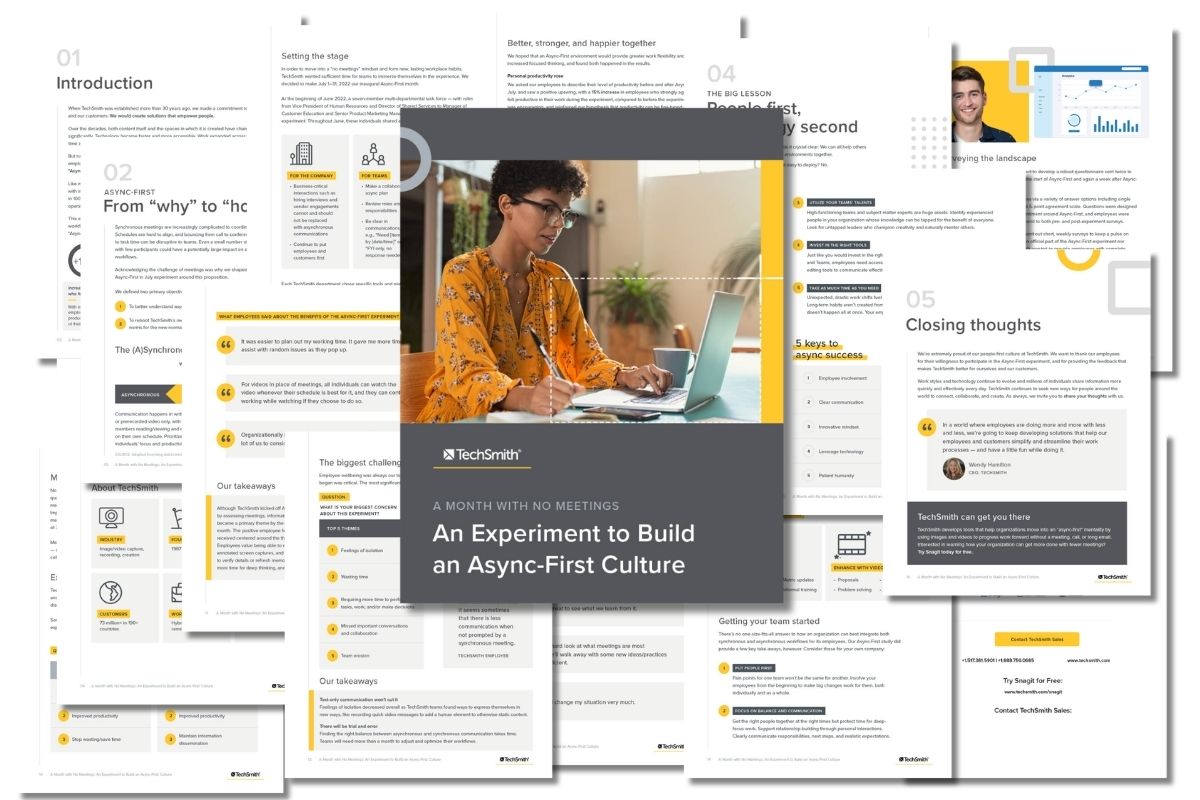
TechSmith was already running a "no meetings" month on Snagit. The partnership designed original research around it — pre- and post-surveys for roughly 250 employees — so an internal initiative became external proof.
The findings were more honest and specific than an easy "Async wins!" message, which is exactly what made them credible and impossible to fake.
- Pre/post surveys capturing attitudes and behavior before and after, quant plus open-ended
- One-question-at-a-time design to cut fatigue; distribution run with HR to protect privacy
- Theme analysis surfacing the nuance — meetings dropped but felt more important; people wanted some sync time back with clearer rules
- An eBook built on the findings, on-brand, engineered to seed a full quarter of atomized content
The Outcome
TechSmith came out with a strategy the team could execute: One brand voice, clear pillars, defined roles, and an atomization model so a piece made once could live across formats. Content stayed distinct where it needed to be and consistent everywhere else. And the quick wins paid off before the strategy fully rolled out: search visitors found the offer they were promised, and messaging led with outcomes instead of specs.
The original research is the part that keeps paying.
It gave TechSmith a first-person story ("We tried something hard, learned from it honestly, and reported what it means for you.") and a foothold in the async conversation the feature-matchers couldn't reach. Not because the rivals lacked budget. Because they hadn't run the experiment, didn't have the data, and couldn't tell the story.
The Takeaway
WHO'S STUCK HERE
Teams producing plenty of content across products or divisions, each pulling in a different direction — busy, well-resourced, and unable to say what it all adds up to when leadership asks.
FOR OTHER ORGANIZATIONS
When a marketing team ships output that isn't building toward anything, the problem is rarely the content. It's the missing foundation — no shared voice, no clear pillars, nobody accountable for connecting Tuesday's post to what customers hear Thursday.
WHAT THIS CASE PROVES
Competitors copy features and messaging in weeks. They can't copy an experiment you ran or the data it produced. If you make something that changes how people work, the strongest story you own is the one where you tried it first.
Build a content engine that supports Your differentiation
Support your team with the insights and strategy to hit business goals — without burning them out. We'll find the story only your company can tell and give you the foundation to tell it everywhere.